Find Your Game. Find Your Squad.
Industry
Sports
Client
Self-Initiated Project
Duration
2 Weeks
Industry
Sports
Client
Self-Initiated Project
Duration
2 Weeks
Overview
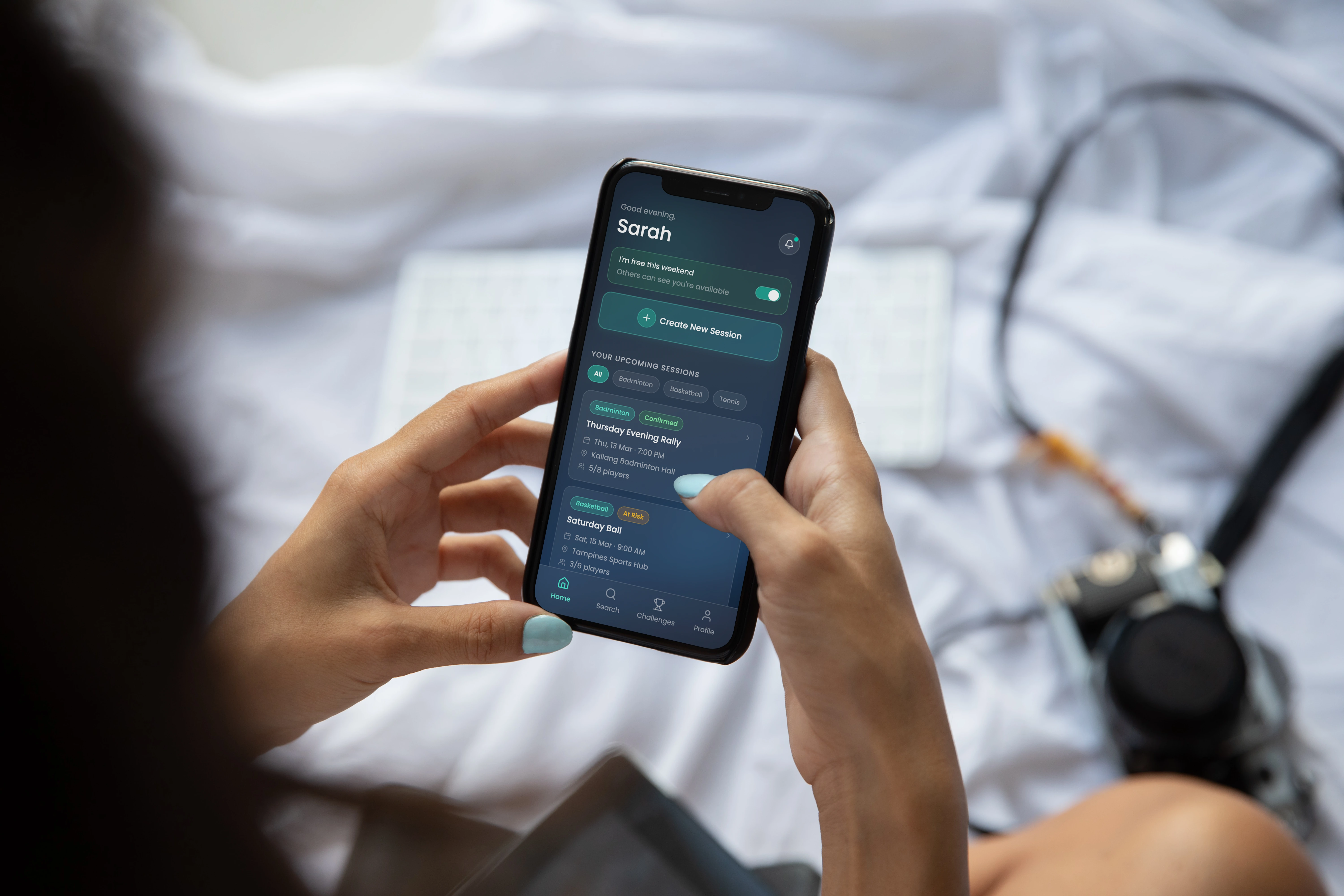
Rally is a mobile app built for casual sports players who spend more time organising than actually playing. It brings together player discovery, session coordination, and last-minute recovery into one place so less effort goes into making the game happen, and more goes into the game itself.
Rally was designed to address all three layers of this problem: helping people find players at the right skill level, making it easy to join or form groups in their area, and building in a recovery mechanism for when plans fall through at the last minute.
The Problem
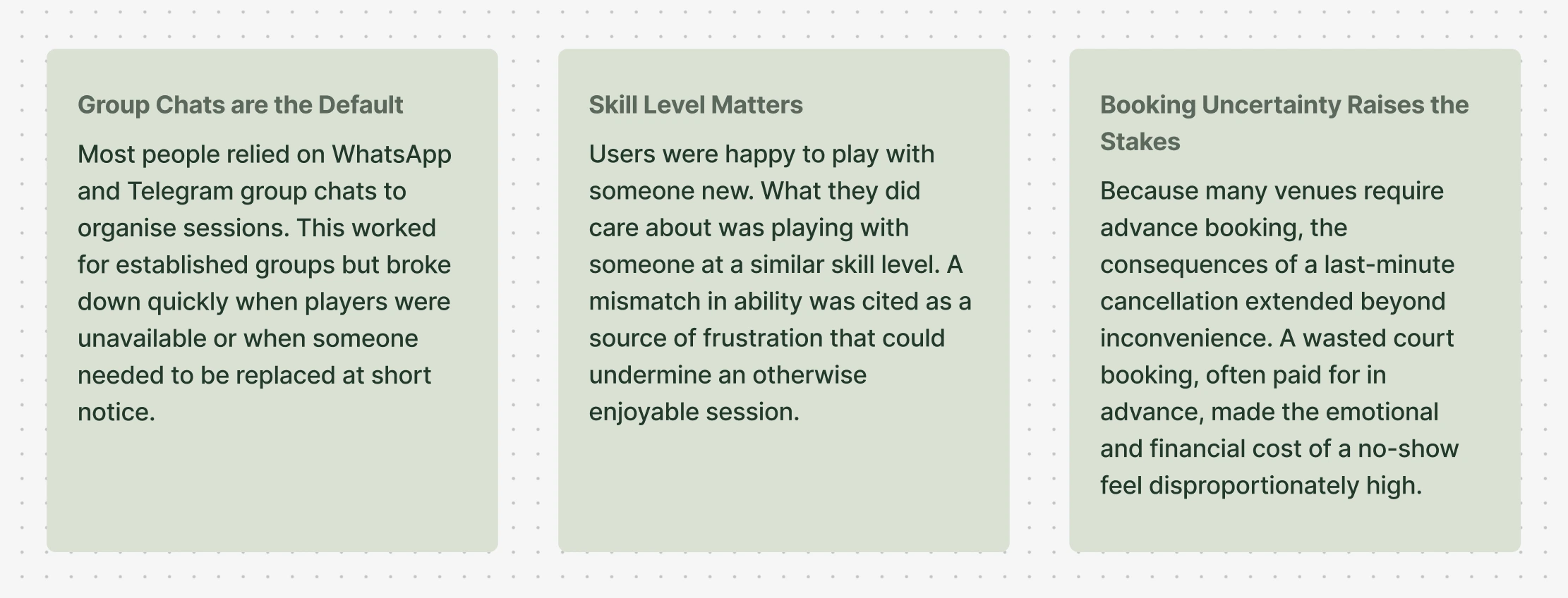
Organising a casual sports session sounds simple. In practice, it rarely is. People who want to play have to find others at a similar skill level, coordinate schedules across a group, secure a venue, and then hope nobody cancels last minute. Most people were managing all of this through WhatsApp and Telegram group chats which was a workable solution until it wasn't.
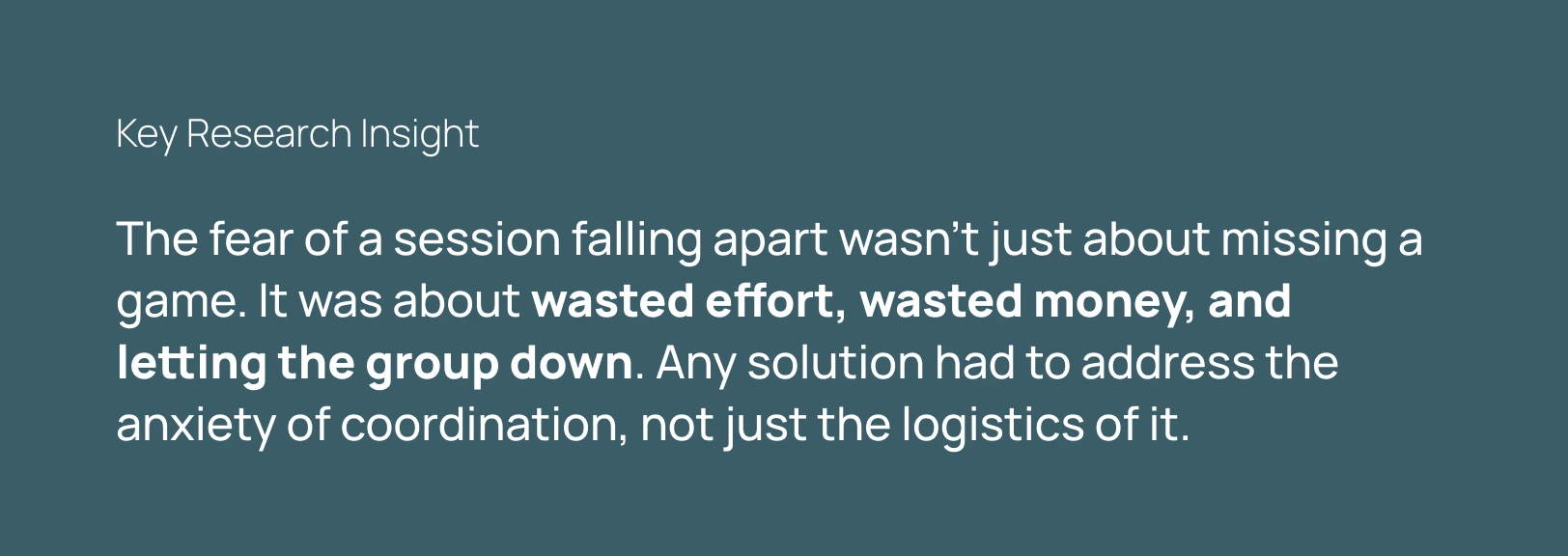
The fragility of informal group coordination meant that a single cancellation could unravel an entire session. And with no easy way to find a replacement quickly, the effort everyone else had put into booking a court, arranging transport, or clearing their schedule was simply wasted.
The HMW gave the project its direction. But to design the right solution, the team first needed to understand exactly how people coped today and why those methods kept failing them.
Research & Discovery
User interviews were conducted to understand how people currently organise casual sports — what works, what breaks down, and what they wish existed. The conversations quickly revealed that the coordination problem was far more emotionally loaded than it might appear on the surface.
Design Decisions
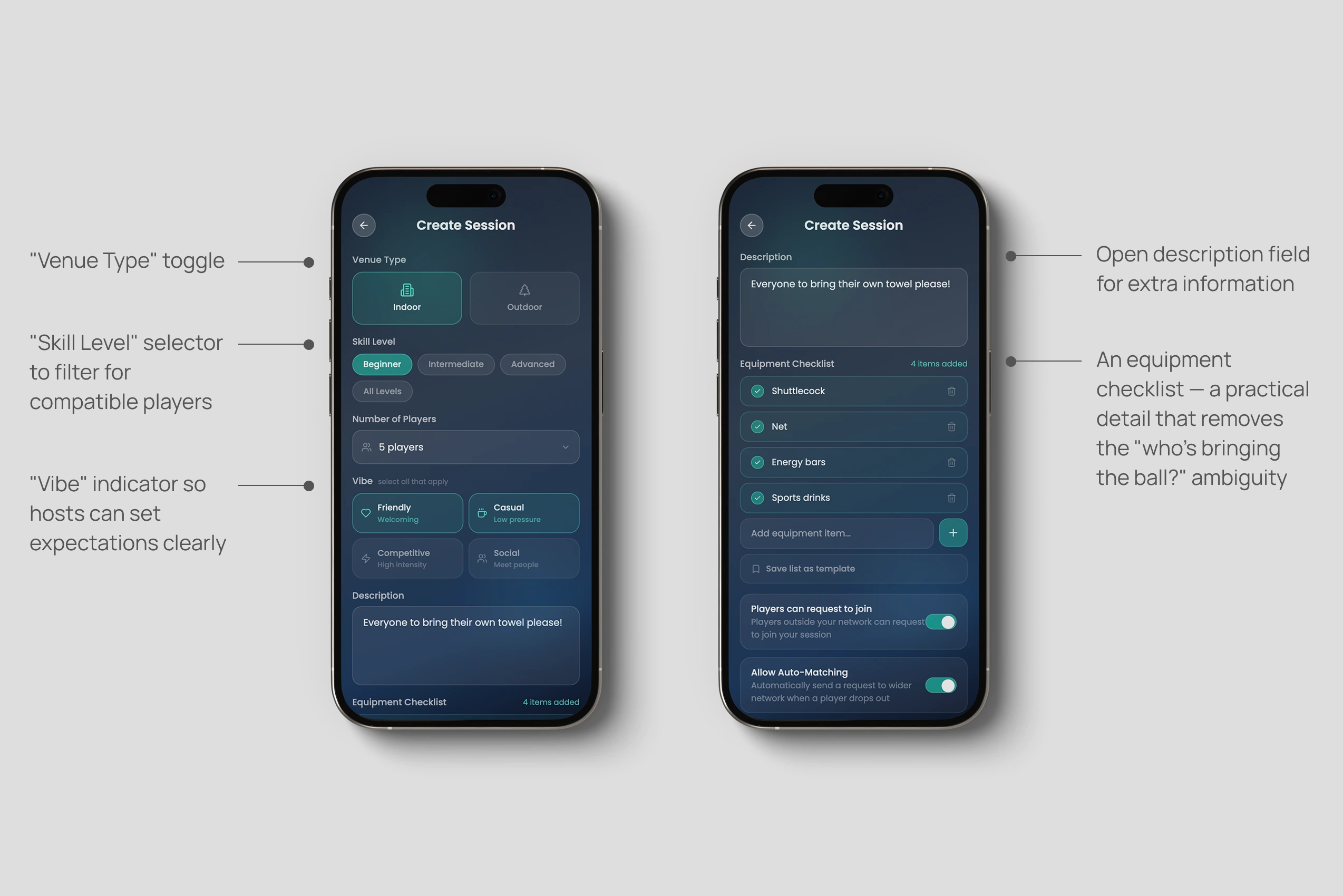
The session creation flow was designed to capture everything a potential player would need to decide whether to join before they even asked. Research showed that players cared about skill level and session intensity as much as time and location. Showing up to a highly competitive session expecting a casual kickabout, or vice versa, was a friction point users specifically mentioned.
This led to the inclusion of:
Auto-Matching is the core feature that addresses the HMW question directly. When a player drops out, the session host can activate Auto-Matching, which automatically sends replacement requests to skill-matched players in the area, starting with the most trusted contacts (past players rated 4★ or above) and expanding outward if needed.
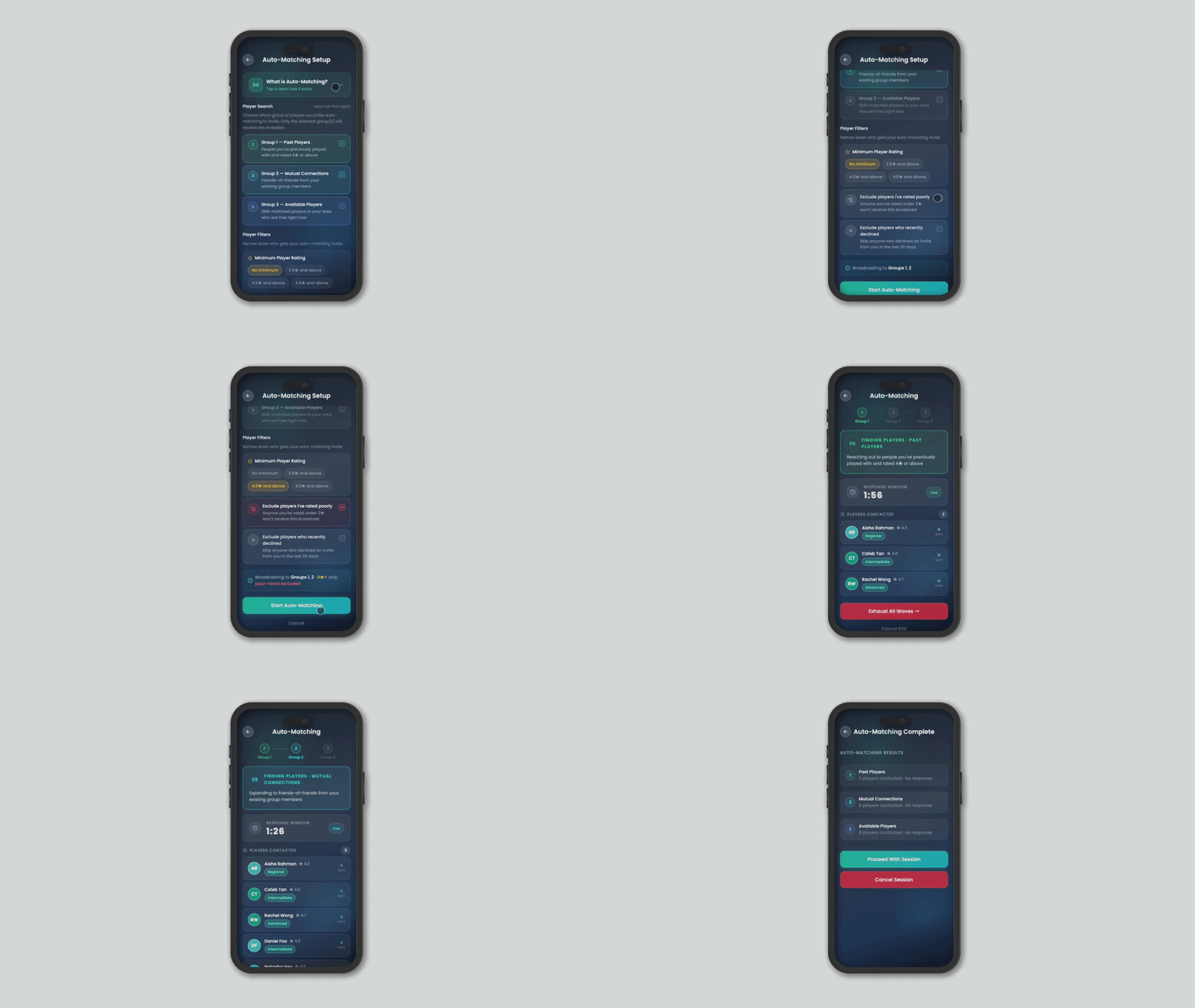
The thinking behind this feature was twofold. First, research confirmed users were willing to play with someone new as long as skill levels matched. That openness was the enabling condition for Auto-Matching to work. Second, the stress of a last-minute cancellation was largely about the speed required to find a replacement through informal channels. Auto-Matching replaces a frantic WhatsApp broadcast with a structured, fast, background process. The host stays in control while the app does the heavy lifting.
The feature was also designed to solve a broader discovery problem: even without a cancellation, Auto-Matching gave hosts a way to fill open spots and expand their regular playing network beyond their existing circle.
What began as a player-search feature would later be reshaped by usability testing into something more useful.
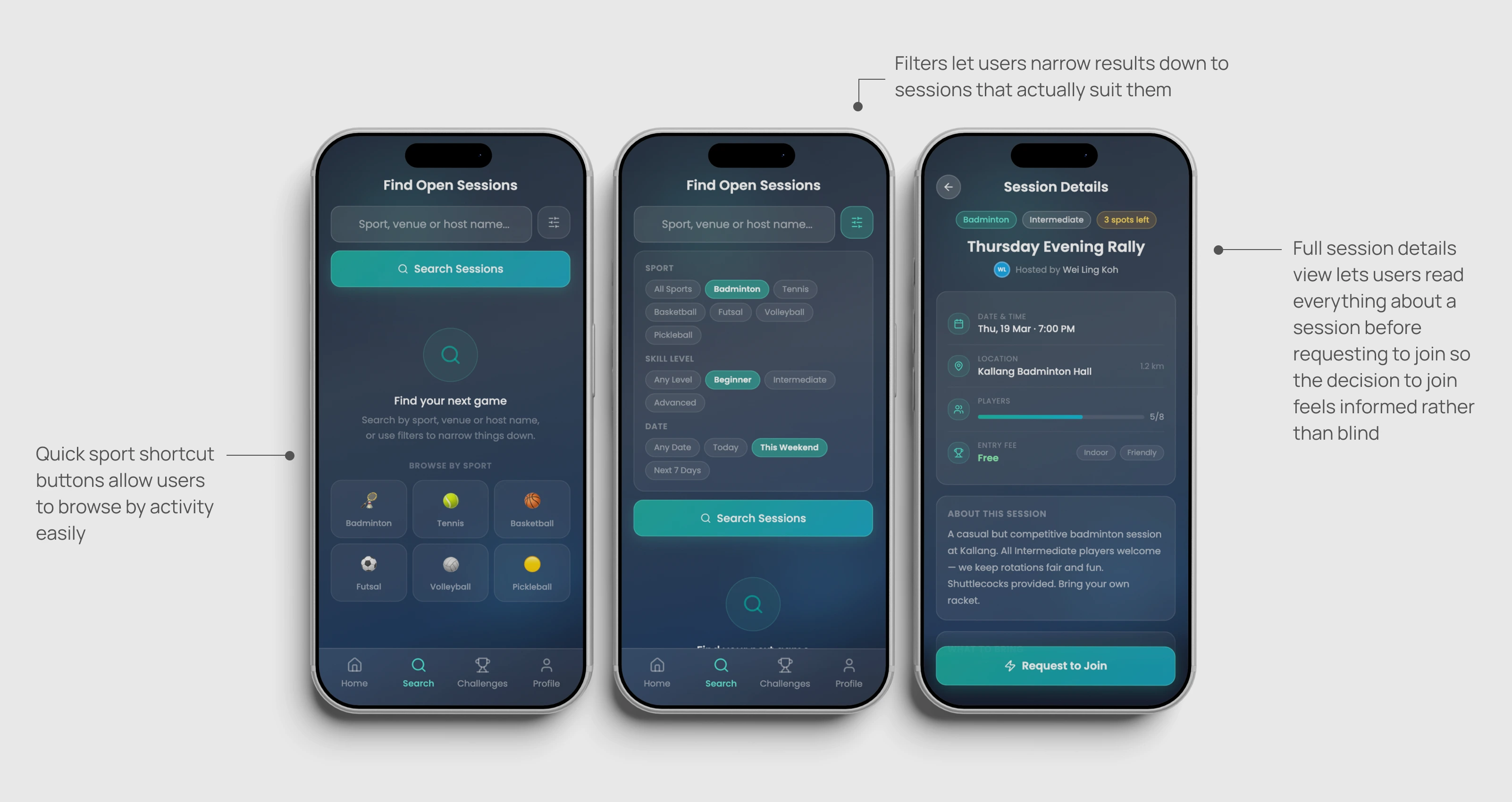
Rally needed to serve two user types equally well: those who want to organise a game, and those who simply want to find one. The "Find Open Sessions" feature was designed for the latter – users who are free on a given evening and want to join something already happening nearby, without the overhead of organising it themselves.
Usability Testing
Three tasks were tested across five users and two of them failed in ways that reshaped the product.
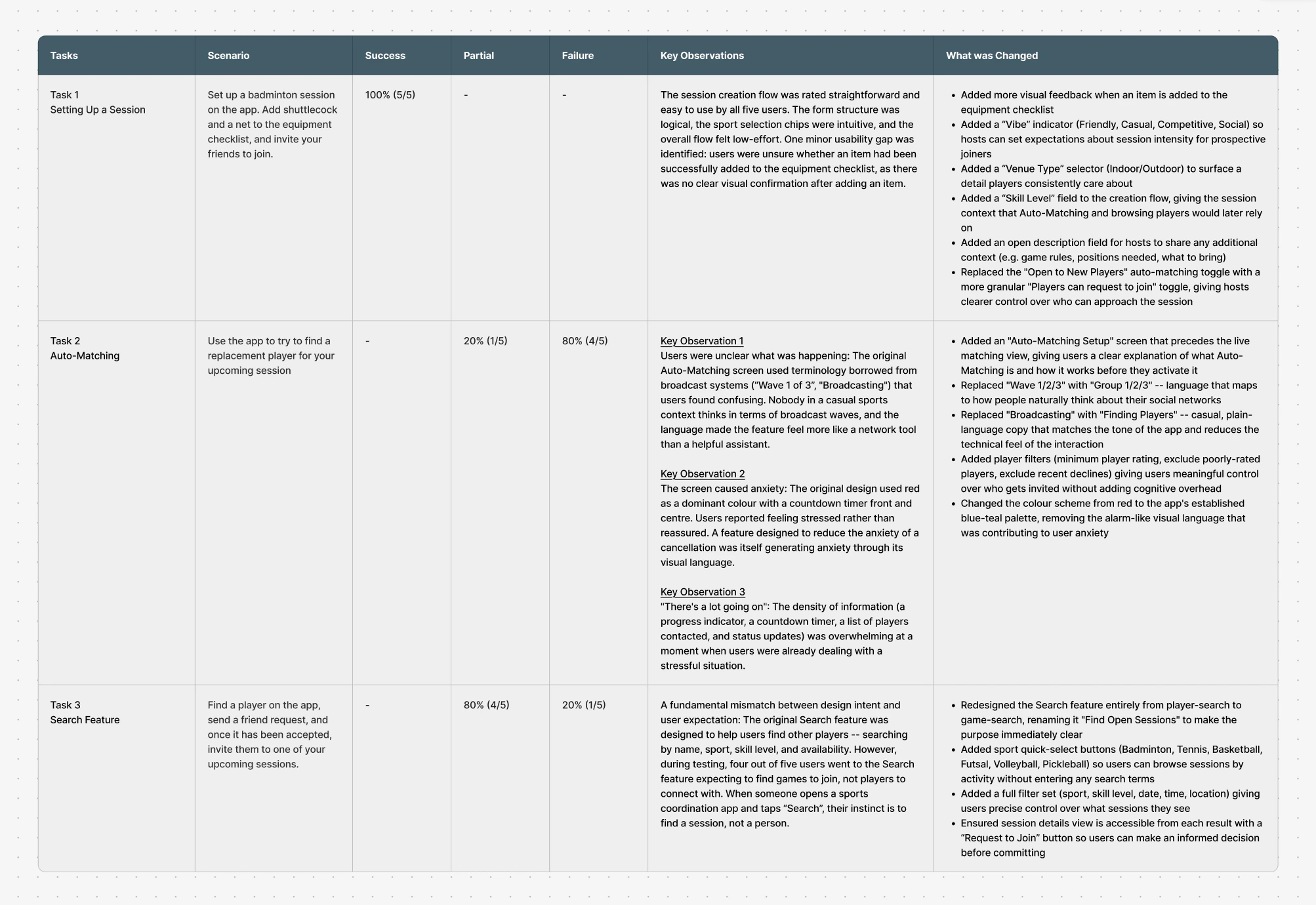
The feature was sound in concept, but its execution was generating the very anxiety it was meant to relieve. A red countdown timer, broadcast terminology like 'Wave 1 of 3,' and a dense wall of status updates left users overwhelmed. One simply said, "There's a lot going on."
The lesson was clear: a feature designed to reduce stress can't look stressful. The redesign stripped back the visual language to the app's calm blue-teal palette, replaced 'Wave' with 'Group,' swapped 'Broadcasting' for 'Finding Players,' and added a setup screen explaining how Auto-Matching works before users ever activated it.
Four out of five users went to Search expecting to find games to join, not players to connect with, which is what it had been built for. This wasn't a labelling problem that better copy could fix. It was a fundamental misalignment between what the feature did and what users instinctively reached for it to do.
So rather than patch it, the feature was rethought entirely: redesigned from player-search into 'Find Open Sessions,' with sport quick-filters and a full session detail view. The failure didn't just get fixed, it pointed to what the feature should have been all along.
Additional Features
Beyond the three core tested flows, an additional feature was designed to support the longer-term relationship users build with the app over time.
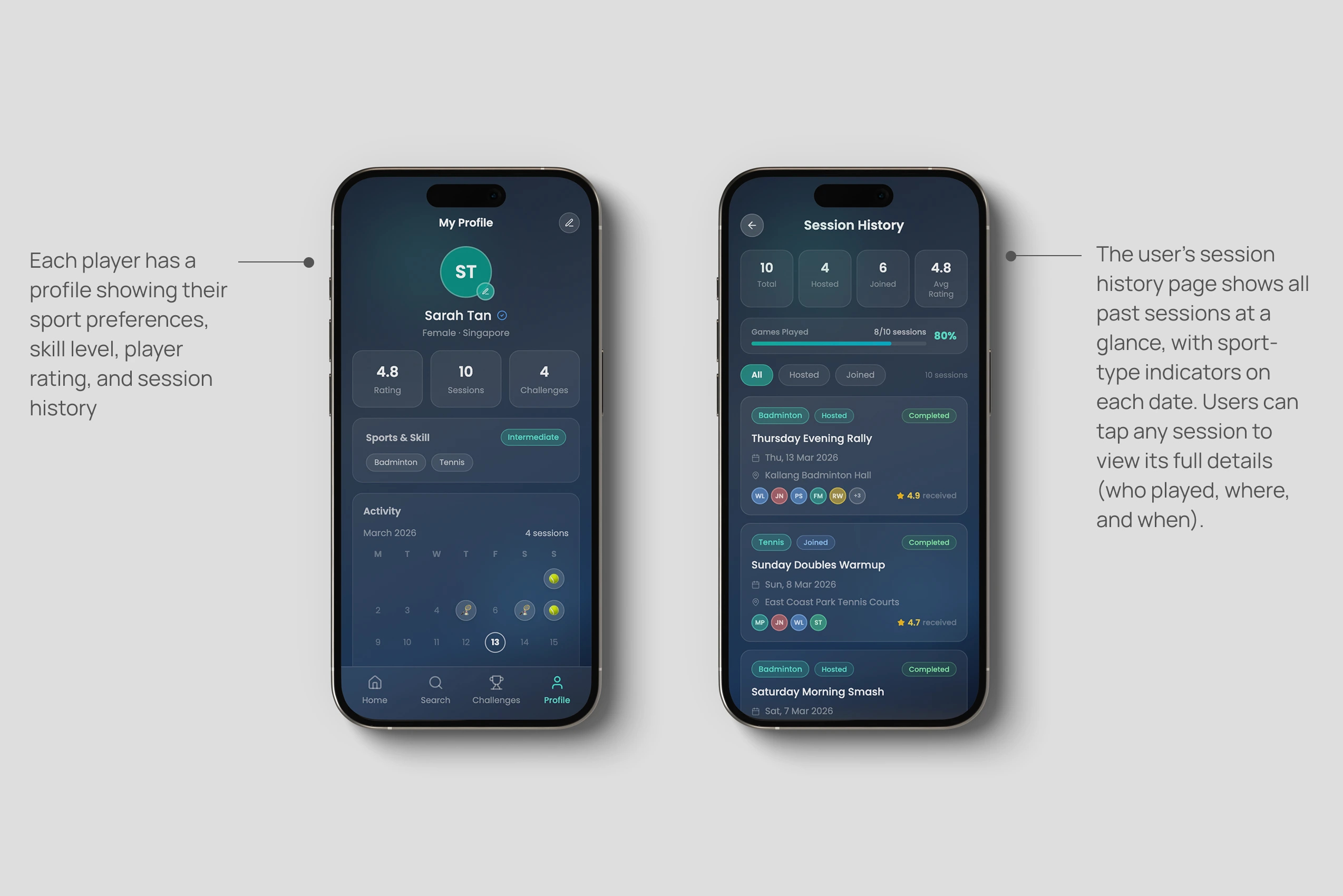
Player profiles are the trust layer that makes Auto-Matching work. When a user considers accepting a match with someone new, the profile gives them the skill level, rating, and session history they need to say yes with confidence.
Conclusion
Rally was built around a problem that sounds trivial until it happens to you: you've booked a court, coordinated schedules, and then someone cancels an hour before. The stress of that moment and the absence of any quick, reliable way to recover from it was the thread that ran through every user interview and shaped every design decision.
The back-and-forth, the follow-ups, the last-minute scrambles, every part of that experience drains energy before a single point is played. Rally was designed with that mental load in mind. By taking the coordination burden off the players, it gives them the confidence that when something goes wrong, the game doesn't have to.